Seeing (Yourself in) Your Art #Blaugust2026

(This is my seventh post in a series of entries I’m using to participate in Blaugust for 2026.)

You may have noticed that each of my Blaugust posts is hung on a hook that is another article (sometimes several), sometimes only loosely related to my topic.

I’m liking the idea of using these as jumping off points, and the whole thing feels far less derivative than the “articles” I’ve frequently found in the past that were “Here’s a video with a paragraph about it that hits word count but really just watch the video.”

There’s a purpose for those, but I want to distance myself from them.

The Setup

With that in mind, PetaPixel has a story on The National Gallery of Art announcing an exhibit “that will trace African American photographers and portrait subjects from the earliest days of photography.”

I like how this got through the draconian policies of our current administration, as acknowledging that any non-white, cishet male existed and sometimes had problems in the 1800s is grounds for content warning signs placed outside your museum these days. (I’m looking forward to the days when people look at that last sentence with disbelief.)

The Tie-In

So here’s the thing: Most of my students are African American. I’m not looking up the numbers for this, but it’s like 95+% of them. It’s so prevalent that in spite of my own heritage being a mix of Irish/Scottish/German one of my students found out only last year that I’m not black. They just assumed everyone in the building was, because everyone in their class was.

(In their defense, they have a sibling who is very light skinned, so they thought I was like their sibling.)

So yeah, I have a student population where, when they see most pop culture media, people who look like them are regulated to the “token black friend” casting role.

Having a whole exhibit that tells them “No, people who look like you have been using cameras for almost as long as they’ve existed” is a powerful thing.

My Students’ Work

One of the things I love about my content area (by that I mean Digital Media Arts) is that it has a district-wide theme of amplifying student voices. I didn’t come up with that, but I feel like it was pulled subconsciously from my brain and put into the official documentation.

I teach in an arts school, where we have multiple disciplines to showcase: Visual Arts (of course…), Dance, Theater, Chorus, I could go on.

But the one I teach? Media Arts? It’s how the others get shown off outside of a school gym.

There’s a hazard to this, though.

Artists usually want only their best work to be seen by others. Artists are also usually their own worst critics. This does not lead to a healthy combination. I’ve students who will avoid handing work in because late assignments don’t get seen and critiqued by their peers.

(They also really hurt grades to a degree that submitting unfinished work will not, but if logic always overpowered anxiety I wouldn’t still have acrophobia.)

And then there’s the teacher involvement.

I’ve long felt that art teachers could be sorted into two categories: Those who presented student work as accurate representations of what the students were able to do, and those who wanted to showcase the best art possible.

Those aren’t the same thing. Everyone makes mistakes, but students have more to learn and therefore make more of them. I’ve seen vis art teachers gluing collages back together, going over drawings with markers to fix the linework, and other atrocities to make the student work look nicer. In the end they had work they were happy to showcase, but saying it was done by the students was not really honest any more.

The Solution?

I’ve many goals for the upcoming school year, but one of them is to provide a wider audience to my students.

Many things get easier by doing them, and showing your work to others is included in that. There’s still a need for curation (self and by others), but having my department be more visible is likely to lead to more students getting comfortable with the idea that others will see what they do.

It’s a lot of work.

I’m not sure I can manage that with all of my other duties, but I can delegate.

Among other things, I teach presentation. I can have my 8th graders work to curate student projects in ways I can share with a wider audience. As the teacher I’ll have to have the last say in what goes live (not to mention managing publicity release forms, etc.), but that’s a small portion of the effort needed.

Having my students do the initial curating removes me a bit from the process, but this is an ideal result. The goal is for STUDENT voices to be amplified. If I become that teacher with a marker to fix the line work, then I’m inserting my own voice into things.

That ruins the whole point of all of this.

Sure, as the adult in the room I need to be the last say in what goes live, but by the time I’m making that call there should be few, if any, creative decisions left.

The next hurdle is in HOW to present the work. I teach web design, but I don’t have a school-approved web host I can use for that.

Google tools are for the most part approved, but students can’t make anything in Google Sites, Docs, etc. be viewable outside of our district.

I understand and agree with these limitations. I don’t want them reversed, that opens the doors to too many headaches, but it does make things harder.

The simplest solution I see is for the 8th grader making the showcase to put the whole thing into a video and send it over to me to import to my own account and change the permission settings so a wider audience can see it. I need to check the whole video anyway, so that’s fine.

Another option would be for them to make a Google Presentation that I again copy over to my own account. Video and audio embedding can be done this way, and it’s actually how our Vis Art department did their art showcases back during our distance learning years.

The issue that arises is that permissions for the Google Presentation aren’t the same as the embedded media. You can see all the slides but then get an error for a video if the video has more restrictions. This is, in fact, something I learned from the aforementioned Vis Art shows.

So I have a rough semblance of the outline of a plan.

It might get changed a lot as I talk it out with the other teacher in my department as well as our school admin.

We’ll see how this goes.

Games, Blocks, & Filters #Blaugust2026

(This is my sixth post in a series of entries I’m using to participate in Blaugust for 2026.)

There’s an interesting read on The Hechinger Report where Jackie Mader has written an article about game sites that avoid school web filters.

(The Hechinger Report, interestingly enough, releases articles under a Creative Commons license. That’s super cool of them, and one of the reasons they’re in my RSS feed reader.)

As is my trend for Blaugust, this isn’t a summary of that article, I’m using it as a jumping off point.

I have a love-hate relationship with games in my classroom.

Also internet filters.

Also, the internet.

Also, computers in general.

All for the same reason, in fact – these things that can be powerful tools for learning are also a student’s go-to for distraction. As someone with unmedicated ADHD, I know the struggle is real.

The difference is in the directions, as with most tools.

I don’t just toss my students at Luanti, I set up a modded server and direct students to complete a task, often one that requires teamwork.

I have students produce game review videos where OF COURSE they have to get some b-roll of them playing the game, but they also have to write up glows and grows (positive and constructive criticism, if we’re being fancy), script things out, record their audio, and overlay everything in post-production.

Many of the reviewed games are hosted on websites that do their best to avoid school filter blocks, which I allow so long as the content is not inappropriate for school. Students will ask what is and isn’t fair game, and I usually say “Imagine I’m showing your review to [Principal], because there’s a good chance I’m going to show it to [Principal] and your parents if you choose poorly.”

That’s usually enough guidance for a 6th grader to make the right call without going over the Student Code of Conduct in detail.

Heck, I’ve had students designing games for close to 20 years. The tools we use have changed, but the core concepts remain.

There’s plenty of reasons to block websites in school, and I’m glad it’s not my job to decide where the line is drawn, but I’ve found in my own little corner of education the easiest path forward is to take the distraction and turn it into a curriculum-based lesson.

I did the same thing with phones, back before my school banned them, but that’s another topic full of mixed feelings for a different post.

5 Things We’re Doing Wrong in Edtech #Blaugust2026

(This is my fourth post in a series of entries I’m using to participate in Blaugust for 2026.)

I recently read an article with a similar name to this one that I’ll not link here, because it made me angry enough to draft a rebuttal.

This is not that rebuttal. This isn’t even a tribute.

Instead, this is my own list, different from the other one, and limited to five things simply to keep this post shorter than a novel. I could go on. I could nitpick. I would rather not invite that poison into my soul this morning.

(And yes, these are in a numbered order, but what that order should be has changed on a daily, sometimes hourly basis for me. I might adjust it after I’ve written all five. I might not.)

#5 We call it EdTech

TL;DR: I don’t like that it’s shoved over to be a separate thing when technology use should be in everyone’s domain.

There’s plenty of reasons to use labels, but doing so fits things into neat little boxes when the world is not so easy to organize.

I’ve been my school’s “EdTech” teacher for as long as it’s existed, and with that comes a concept held by too many people that I hold a fiefdom over all that has blinking lights and LCD screens.

We’ve moved away from that a bit in the past 6 years (I wonder why…) but the problem persists, with teachers using class Chromebooks for unsupervised “independent study” time because they’re not “techy” enough to do more.

In truth, any technology is a tool that makes life easier for those who are using it. (If it’s making life harder, someone’s doing something wrong.) The first of our ancestors that learned a pointy stick kept their food from running away was using technology. It should not be mystified just because now a lot of it has rocks we tricked into doing math.

There are plenty of people who make loving tech their whole personality and try to build walls up so anyone not on their level doesn’t get to be “in the know” and learn how to use the tools. Those who just want things to work don’t need to help build those walls.

#4 We Let Capitalism Lead It

TL;DR: Nothing in education should be a for-profit enterprise, because that shifts priorities to making money, not supporting students.

Schools, traditionally, are underfunded. Underfunded schools do not traditionally have a lot of money to spend on technology. Therefore, schools will frequently look for the free and/or cheap options.

This means the schools will have tons of open-source software running on refurbished hardware, right? Hahaha, my lab is an outlier and does not get counted.

No, a lot of the tools we use are “freemium” to get us hooked before charging for more features, or ad supported, or have data collection, or are provided at steep discounts so that students (and teachers) get locked into the “but I’ve always used [thing]” mentality.

Look at what Apple did in the 1990s. All of those Mac labs existed for a reason, and it helped keep them afloat for years.

Google’s doing the same thing with Chromebooks, and they don’t even need to deal with hardware or marketing to make it happen.

Sure, to be in my school system they have to promise to not collect any data on our students, but this is Google. If they have someone locked into their ecosystem by 3rd grade then as soon as that kid creates a non-student account the data collection and selling begins.

Adobe makes me the angriest, though, as even my own colleagues in the past have said their students needed Adobe Creative Suite to be successful. Why? It’s the industry standard. Why? Because everyone uses it. Why? Because it’s the industry standard.

There’s no such thing as a free lunch, I know. Using open source software in my lab requires me to do more work installing and maintaining things, but my students will still know WHEN to make the cut from one scene to another.

#3 We Lowered Our Standards

TL;DR: Some tools we use are garbage, but we still use them because they’re “educational.”

A long time ago I was really into a handful of Christian Rock bands. Alas, only a handful, because the rest were … developing their skills. Christian Rock was a small enough niche that a band could get their foot in the door and be on the local Christian Rock radio station with a level of quality one could not find on any pop, country, or oldies station because the bar for those was too high.

Most “educational” programs I’ve played with have either been heavy on the fun with a glaze of flash cards on top or heavy on the flash cards with showing a point total to make it “gamified.”

I’ve had far more success taking tools never meant to be limited to the classroom and having students make things with them. Kdenlive isn’t a video editor for kids, it’s a video editor. The lesson is in learning how to use it, and it doesn’t need a cartoon mascot for that.

(Although Tux Paint has a cartoon mascot and is super fun, so there’s always exceptions.)

#2 We Abandoned Old Successes

TL;DR: Things that work well don’t have to be dumped just because we found a new thing.

Remember when blogging and podcasting were big in education? No, not recently, I mean the first time, back in the ’00s, before some of my coworkers were born.

How about game based learning? Gamification? (You know those aren’t the same thing?)

Each of these was a trend that was popular for good reasons that just faded away to obscurity, not because it got worse but because the next new trend showed up and there was only so much time in a school day.

#1 We Jump on Bandwagons Because They’re Bandwagons

TL;DR: If not adopting AI will have me get left behind, then I will leave you to join the lemmings and be here when the bubble has burst with my cognitive skills intact.

I’ve seen a lot of fads come and go: ’80s hairstyles, Bitcoin, NFTs, and candy colored computers are just some of them. You can still find fragments left behind, but they are all shadows of their former selves.

AI is one of these trends, with companies relabeling rather tame algorithms as “AI” because that’s the buzzword of the day.

It disgusts me that so many EdTech “leaders,” some of whom I respected in the ’00s, have seen this as the next big thing and hitched their wagons to it.

Gotta make a buck somehow, if your income is public speaking and book sales, I guess.

Whenever I converse with an AI advocate, I get the same talking points:

  • “You’re not teaching your kids what they need to know.”
    • My students know how to make movies. Yours know how to write a prompt and have a program steal other movies and mash them together to make something that looks the same as every other AI generated piece of slop. Our classes are not the same.
  • “It gives you more time for the important work.”
    • Everything AI generates is subject to errors, and people are getting in trouble when those errors slip through. It takes me less time to make a thing than it does to double-check the output from a plagiarism engine.
  • “It helps students learn.”
    • Citation needed. (I’m never provided any when I ask.)
    • Any time the work is done for my students, they don’t learn. My kindergarten students don’t learn their passwords in classes where the teacher types it for them, but in my class most of them have it down in two weeks. They learn by doing. If AI does the work from them, what are they learning?
    • I teach HTML coding. AI can write code, but AI written code is very hard to maintain. I can look at my hand-coded websites and edit them. My students can do the same. Yours can, what, ask the AI to do better this time?
  • “It’s cheaper than paying an artist.”
    • Theft usually is. Knowing how to steal is not the flex you think it is. Telling an art teacher that kids should know how to steal from artists is certainly a choice.

One last thing about the AI bandwagon that is spreading like a cancer: The people making money in a gold rush are the ones who sell the shovels.

The established shovel makers aren’t building more factories. They see the bubble for what it is, and don’t expect it to last long enough for a new factory to pay for itself before the bubble bursts.

When that happens, I’ll be here – still teaching how to make cool things without typing prompts into a souped up spellchecker, while others have forgotten how to do anything without asking an AI for advice first.

The Problem With Talented and Gifted #Blaugust2026

(This is one of a series of entries I’m using to participate in Blaugust for 2026.)

Russell T. Warne has an article over on Education Next about the Gifted (or as some districts call it, “Talented & Gifted,” or “TAG”) program and some of its flaws. This isn’t a summary of the article, I’m just using that as a jumping off point.

I’d like to think I know a bit about the Gifted program. In 5th grade I was labeled Gifted and later I became both a TAG teacher and coordinator. I’ve had the small desk, big desk, and run-around-the-building positions for TAG, something not everyone gets to say.

The Small Desk

My journey in TAG began after taking an IQ test, a method I consider to be outdated based on both Gardner’s Theory of Multiple Intelligences (I was taught Gardner in the ’90s, talking about “Intelligence” like it’s one monolithic thing should be reserved for history books and RPGs) and the more recent concept of Growth Mindset.

Regardless of the inherent inequalities in that system of identification, I benefited from it … mostly.

Some of the things we did stuck with me, even now, decades later. I remember playing a competitive stock market game and my team winning, out of mostly sheer luck. I remember working collectively on a model airplane that we never actually finished. I faked a UFO photo with papier-mâché and a Polaroid camera, fooling a significant percentage of my grade level.

I got “enrichment” experiences that I would not have otherwise had, thanks to a poorly designed test that said I met the minimum requirements. They left me more rounded, with a better understanding of what I would and would not like to try later in life.

The Big Desk

For a time, I was my current school’s TAG teacher for grades 4-5. It was a lot of fun, with the program revolving around students identifying problems and inventing creative solutions. Keep in mind that for 4th graders, sometimes a problem might be “I don’t have a cardboard robot costume.”

I was 100% for this. We were a pull-out program, so students missed instructional time elsewhere to attend my class once a week (where I also missed planning time) but hey, they were “gifted,” they could make that up, right?

Then 2020 happened and a lot of changes took place. There were multiple ways to handle distance learning but I ended up not enjoying the changes that were made. As I was teaching TAG for the fun of it and not for the stipend, I asked to not be the TAG teacher and my principal took no issue with that.

TAG Coordinator

My last few years as a TAG teacher I did double duty as my school’s Coordinator. I won’t lay out all of the duties here but my primary responsibility was to be one of the front-line people identifying who was eligible for TAG based on my school system’s requirements. (Oh, hey, Russell T. Warne talks about that in the article I linked!)

My school system had (and I assume still has, but I’m not a Coordinator now) a much more lenient method of accepting students into TAG. Again, I’m not going over all the bullet points here, but nowhere in the multiple factors we examined did we ever consider IQ. Being Coordinator was a thankless job, but I’m glad I got to learn how things work. I wouldn’t touch it with a 10 foot pole unless I was still teaching TAG, though. Most schools, the TAG Coordinator is office staff or an administrator.

The Problem With TAG

Alright, now that you have my life story, here’s the part I’d be able to fit into a post on Mastodon:

In my experience, the parts of TAG that benefit students in the program could benefit ALL students if we just opened it to everyone. The parts of TAG that make learning more engaging are perhaps needed even more by students who are not achieving enough to qualify.

There’s no magic switch that makes the TAG program better if you have a label, and nothing that makes it cease to be good if you lack it. We could teach the core concepts to everyone, but we don’t.

At least, not officially.

There’s lots of reasons why, and I’m not about to take a position outside the classroom in order to address them, but I suspect it boils down to resource allocation. TAG costs money and time, both of which are in short supply in most schools.

(There’s also the non-zero possibility that someone thinks that if all classes are TAG then there’s nothing that makes the TAG classes stand out, but that’s idle speculation based on nothing I’ve seen or heard in regards to my district’s TAG department.)

But here’s the thing: If you’re blessed with a curriculum that allows for flexibility, you can just … have students do TAG lessons anyway. I know not every teacher has that option, some admin expect everyone to be on the same lesson in the curriculum on the same day.

But I do have that freedom, and so do many arts teachers.

So that’s what I do.

PUWT18 Presentations

As is apparently tradition for me, I’m presenting two sessions at this year’s Powering Up With Technology Conference. (My first presentation at PUWT was … 2006? 12 years ago? Wow!)

Rather than give long and difficult to type URLS for my presentations, I thought I’d share them here. (Yes, I am aware that “academicaesthetic” is not universally easy to type, but it’s easier than, say, “o03Eil5s,” and people can get here from AaronBSmith.com … hm, maybe that’s the link I’ll share.)

Keep in mind that these Google Slides are primarily my visual aids, as opposed to the talks themselves, and I’ll probably be changing slides around up to and including 5 minutes before my session starts. If all goes well I’ll have recordings of the actual presentations that I can post on this website as a follow-up.


Will This Be Graded?

This post brought to you by…

Let’s talk about assessment.

OK, now that I’ve scared off any random students who’ve managed to find my website, let’s have an honest talk about assessment.

Grades in one form or another have been a staple of education for a very long time indeed. With the push to quantify school quality through standardized testing and the overall inertia that we normally encounter in academia in general, they don’t look like they’ll be going away any time soon.

So naturally, they’re a perfect thing for progressive ed reformers to rally against. Kids hate them (unless they have an A), teachers hate assessing which grades to give (unless it’s self-grading), and parents hate having to come in for parent/teacher conferences to discuss them, so let’s trash them, right?

… and the letter Y.

Not so fast.

Grades, like paper in an art room, still serve more than one essential need in the classroom. Unlike slide rules and filmstrip projectors, we still use grades because we haven’t come up with a better alternative for them. They work.

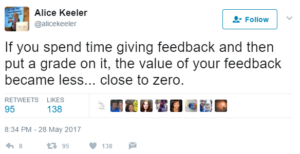
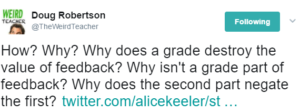
Let’s start with the point that Mr. Robinson brings up in his initial rebuttal: Feedback.

Grades on individual assignments let students know the skill with which they completed the assigned task. Those grades can (and should be) itemized in such a way that students also know how well they accomplished various subcategories of the skills being assessed. Their cumulative grade (which if done well should be accessible at any time, not just when Progress Reports or Report Cards are sent home) helps students know how well they’re doing in the course overall. Ideally they should have some idea about how much each assignment weighs against the other tasks they are given throughout the course.

Yes, I can give feedback just through constructive and positive criticism, but while those things are crucially important parts of my curriculum, the ability to boil something down to a number or letter can help the student better understand their growth than me just saying “Hey, that was reasonably better than last time!”

That’s NOT a #2 pencil!

Next up: Grades do the same thing for me that they do for the students.

For the past eight years, my grade book has been a Google Sheet with more annotations, comments, and conditional formatting than is healthy for any web-based system. It is packed full of additional information that explains or clarifies various scores and why they are what they are.

This is incredibly useful information that I’ve gone back to on many occasions throughout the year, but it doesn’t beat being able to highlight the row a child’s scores are in and scroll across to see trends in the data. I can do that with numbered (or lettered) grades far faster than I’d ever be able to do that without them.

I’ve often complained that education is a dinosaur that needs to do some serious evolving if it’s to continue to be meaningful and helpful to our students, but when it comes to getting rid of grades? That’s throwing the baby out with the bath water.

There are a few kinds of assessment that I could do without (Die, standardized testing, DIE!), but let’s keep grades around for a while. They haven’t failed us yet.

Pun intended.

5(ish) Photography Lesson Ideas

Lesson ideas:

  1. Take 100 unique shots of the same item and/or in the same location. (The first 50 or so will likely not be so good. After that, students will be forced to think.)
  2. Photograph something being made (Lego sculpture, a meal, a painting, etc.) with the camera in a different location in regards to the subject in each photo.
  3. Document an outside (not in a car) journey from the point of view of your feet. Capture as many landmarks/areas of interest as possible.
  4. Create a series of images where the subject is only seen in reflections (mirrors, windows, still water, etc.), bonus points if it is interacting or lining up with the non-reflected parts of the composition.
  5. Watch the video below for inspiration.

Getting Homework to Work, Part 2

Yesterday  I started documenting my efforts towards making homework enjoyable enough for my students to actually do it for a change. By the end of that post I’d set up a weekly assignment where students made a video series as if they were YouTube stars. There was a definite increase in participation and quality, but I wasn’t quite done.

Binge Watching Isn’t So Bad.

I started by taking all of the homework videos submitted over the previous week and throwing them in a folder in Google Drive. My district uses G Suite (formerly GAFE, or Google Apps For Education),  so I’m one of those lucky ducks with unlimited storage space.

In the past I’d tried tossing them all into a playlist and showing them in class on my LCD projector, but with a 1:1 ratio in my lab there was nothing stopping me from letting students watch and critique these videos at their own pace.

For convenience I also renamed all the videos following a specific naming convention. If John Doe submitted a 2 minute 11 second video for the 3rd video in his series, I named it 3_JD_2-11.mp4. This was a marked improvement over the previous names, which ranged from “My Edited Video” to “12345.mov” … I wasn’t grading students on how they named their files, so long as they uploaded the right ones.

With all the videos in a folder that I could share through Google Classroom, I was almost ready to go.

Will This Be Graded?

It doesn’t matter how enjoyable an activity you design, there will invariably be someone who asks if it’s going to show up in your grade book. I personally have an aversion to assigning “busy work”  because  I end up making myself busier as I grade something that was meant to be filler, but  there’s still that student, as dependable as death and taxes, that will ask if THIS time I’m giving them work that doesn’t matter.

Nope, it’s not enough to do things out of the goodness of your heart, you need numbers to go with it. Numbers I am happy to provide, in fact, so long as you give me a few in exchange.

I took all of the renamed videos and put them in a Google Form. I made it a “Dropdown” question, since otherwise my students would be scrolling for days.

(Pro Tip: If you don’t want to type everything in, you can’t select text in Google Drive’s web interface but you CAN  tell your browser to print the page. When the preview shows up, DON’T press the print button – the text in the preview page  can be selected, copied, and pasted into a Google Form. You’ll get some extra lines you’ll need to delete, but that’s easier than typing everything by hand.)

Then I added four “Linear Scale” questions that my students would use to rate the videos they watched. We’d already talked in class about these categories, so they were familiar with   them and didn’t need much in the way of explanation.

I capped it off with “Short Answer”  questions that allowed students to offer some criticism.

After the critique is over I  find the average for each category and then add the four categories up to get a score out of a possible twenty points. Critics get a score as well, earning one point for every three minutes of video graded.

Testing Boundaries

Of course this  has not always gone smoothly. There have been students that thought single word critiques, or pasting in the same sentence for each critique, were acceptable. One day when I was absent half the class invented time travel and managed to critique all the videos in  a tenth of the time it took to watch them.

I caught those students, because timestamps are a thing and I refused to treat this like something meant to save ME time and energy.

I’ll say that again: Letting students grade and critique student videos IS NOT faster than grading them myself.  I still have to watch the student videos  (why wouldn’t I?) and if anything I spend more time grading critiques than I did grading videos. I’m sure as I keep doing this I’ll find ways to streamline the process, but that doesn’t mean I’ll have more time for video games afterwards.

Keeping What Works

The goal was to get more students to start submitting their homework videos, and it’s working. My kids, with some exceptions, like writing comments when they know their classmates will read them. They like making movies when they know their classmates will write comments.

But what about the grades, you might ask? Won’t the students just give each other 5/5 on everything? There are a few that give incredibly high scores regardless, but with anonymous grading (on the student end – I see everything) and a class my size, it mostly averages out. Even if they did collude to give each other high marks, my homework grades are mandated by my district to count significantly less than my assessment or classwork grades.

Overall the scores are SLIGHTLY higher than what I’d give using the same rubric, but well made   videos still score higher than lower quality ones.

And they’re   getting better.

As a member of their audience, my students can take me or leave me. I’m far too old and out of touch with today’s youth for my opinion to mean much. But their peers? Those are opinions that mean something, and I’ve given my students enough training for them to point out what areas of technique need improvement.

So there you go. Your mileage may vary, but this setup seems to be working for me. All it costs is one class per week for critique and a significant portion of my planning time to organize and grade the  commentary, but the end result is students getting better at something they actually like to do.

That works for me.

Teaching Criticism With Spam

In the near future, I’m going to be sharing some spam with my students, and not for the reason you’d think I’d do it. While teaching how to tell the difference between actual important emails and unsolicited commercial and/or malicious emails is important, that won’t be the primary goal.

In addition to everything else I teach, part of my curriculum involves criticism. We as a culture of consumers frequently elevate critique itself into an art form – one so high that we generalize its practitioners into a league of toga-clad experts, giving thumbs up or down as various creative works battle it out in their arena. (The critics loved it! The critics panned it! The critics said it wouldn’t do well but look at the box office numbers, so what do they know?!)

You might think that things are different now that there are services that crowd-source ratings, and you’d be right. Rotten Tomatoes and Yelp are the first that come to mind, but Amazon’s reviews and YouTube’s Like and Dislike buttons also come in to play here.

Unfortunately, not all crowd-sourced criticisms are created equal. The goal of my upcoming lesson will be to improve how well my students articulate themselves when critiquing things they like or dislike.

The main example I intend to show will be a little gem from this very blog’s spam filter:

Seems like a nice bit of commentary. I mean, they’ve told me I have room for improvement, but they lead with something nice to say so the comment seems thoughtful and well-rounded.

What’s my point?

Guess which post they were commenting on.

This comment could more or less be attached to any of my posts where I explain something and still have it mostly make sense in context. There’s nothing in here to show that the person who wrote it actually read anything on my blog other than the tag line, and that we can only guess because their name and web address (which I censored since I’m not giving their college loan site free advertising) have something to do with education. OK, it was probably a bot that posted, but technically the bot still reads key words.

This is a common attribute for spam, but this is not something I expect from students.

I’ve recently ramped up the amount of time spent doing peer critiques in my Media Arts classes. The main setup is the subject of a blog post for another day, but one of the hurdles we have to navigate involves generic criticism.

It’s all well and good to say that you liked a video. It’s also OK if you say you didn’t like it, since not everyone has the same tastes.

But neither of those opinions works well in a critique setting if you don’t say WHY. The more my students dig down into their reasoning, the less likely they are to give criticism that would get caught in a spam filter.

That’s the goal, anyway.

We’ll see how well it works.