Academic Aesthetic Podcast 97

This time around I talk about personal professional development.

Today’s the first day of school for students. Summer vacation is but a memory, as now it’s time for all of us to buckle down and do some serious learning.

Yes, I said “all of us.” You may be a teacher, but you’re not exempt from learning until you’re dead. (And perhaps not even then, but I digress.)

There are many ways for teachers to expand their skills as teachers. There are inservices (well, at least the good inservices…), graduate courses, and more literature available for self-paced study than you can shake a stick at.
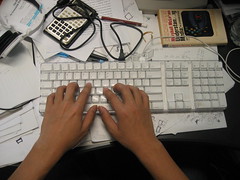
Of course there’s another way, too. Remember all of the times a teacher has asked a class to write a report on something? Did that teacher honestly need to know more about that subject, or did he or she want the class to explore the subject themselves?

I suggest that we, as teachers, should all write reports regularly in order to help improve ourselves. Now I’m not suggesting 50 page papers on Mediaeval France, unless of course you’re that much into Mediaeval France. Rather, I propose that we write shorter essays on educational topics at least once a week. Trust me, it doesn’t take as long as you think to write up a single page of thoughts.

If you have a brainstorm and come up with several ideas at once, make a list and save them for later. I thought of two topics this morning before I came up with this one on the drive to work, but those other ones are safely recorded for future droughts of inspiration.
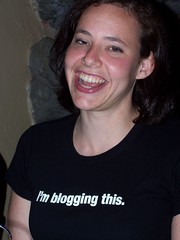
These essays could be kept private, but I hope that they wouldn’t be. One of the basic tenants of education is the sharing of knowledge, and you don’t need a doctorate to share concepts with your peers.

The only question is what media would best be used to share these essays with the world? It would have to be something easy to use, and something that would allow readers to give you feedback would be a plus.

I think I’ve heard of something like this somewhere. If only I could remember what it was…


Why don’t you send me an audio comment for my 100th podcast? Only a few more podcasts untill the big event!
Academic Aesthetic Podcast 95

artclublabToday many of the art teachers in my county got together for a beginning of the year inservice. Along with the free art material sample packs and lesson workshops, we also had time to hobnob and network.

HPIM2038While having lunch with a high school photography teacher, I shared with him my desire to expand my lessons that involve digital photography. He let me know that when his students use digital cameras he tries to get them to do as little post editing as possible, so that he doesn’t cross the line from photography teacher to computer graphics teacher. (His school has one of each, and he doesn’t want to step on his coworker’s toes at all.)

brushesicnThis made perfect sense to me, but as I’m less an art specialist than a jack-of-all-trades, I don’t feel that I need to stick to the same limits. To be honest, my requirement of aligning the art curriculum with other subjects means that the more circles I have in the venn diagram, the more likely I’m doing my job.

This also got me thinking about technology. (but then, what doesn’t?)

techicnSometimes I’m referred to as an art teacher who’s into technology, or a technologist who’s into art. Do they really have to be separate things? It’s my opinion that anything that allows for creative expression is art, and therefore fair game for one of my lesson plans. It’s true that there’s some art that normally falls outside of the realm of the digital, but scanning it or taking a picture can quickly change that issue.

writeOn the other side of the spectrum, I can’t remember the last program or website I’ve seen that didn’t have an artistic touch to it. (The BIOS doesn’t count.)

I’ll wrap this up with a question from one of my colleagues. Today I was asked if I’d ever considered teaching technology all the time.

I answered without hesitation:

“I already do.”


Why don’t you send me an audio comment for my 100th podcast? Only a few more podcasts untill the big event!
Academic Aesthetic Podcast 94

I’m not from Australia.

I have nothing against the land down under, but I can’t even fake a decent Australian accent. I bring this up because a recent posting on a blog called “Using Wiki in Education” gave me a nice write-up, but got that minor detail incorrect.

I’m sure the author, one Stewart Mader, wrote the inaccuracy as an honest mistake. This is unfortunately more than I can say for some others out there.

It seems that people wiping their feet on the truth are coming out of the woodwork. Wired News had to pull more than one story by a freelance reporter who faked his sources, Reuters got its own black eye thanks to some doctored photos, and don’t get me started about fake MySpace accounts.

You’d think that at least textbooks would remain pure, with all of the checking and rechecking before they go to print, but no. I’ve used both art and health books (Yes, I taught health. My training as a Boy Scout and the son of an RN worked out well.) where I had to say “The book says this, but in reality, this.”

This all goes to show how much we need to verify our sources, and how much we, as teachers, need to teach our students that not everything they read is true just because someone managed to publish it.

Just think – if we could raise an entire generation of people that weren’t gullible enough to fall for spam, junk email might actually cease to exist. A daydream, I know, but hope springs eternal.


Why don’t you send me an audio comment for my 100th podcast? Only a few more podcasts untill the big event!
Academic Aesthetic Podcast 91

I’ll be in Pennsylvania all next week to visit with friends and family and perhaps spend a day or two at Musikfest in beautiful Bethlehem, PA. This doesn’t mean that I’ll be taking a break from podcasting, although I probably won’t be posting the MP3s in the middle of the day like I normally do.

This will be my last big fling before I head back to school, and I’m really looking forward to this coming year. I may not have a classroom to set up, but after two years in the same buildings (more or less) I’m familiar enough with the curriculum to start planning my lessons.

I’m actually under more restrictions than you might think. As an Interrelated Art Teacher I’m not allowed to just stroll into the classroom and teach whatever I want. insects.jpgI have to develop lessons that don’t just match the state standards for art, but also the standards for other subjects.

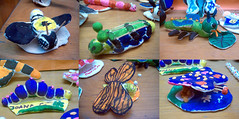
So my 3rd grade origami lesson must also be a review of fractions and geometry. Or when we use Model Magic to make insects my 6th graders need to identify the body parts by their proper names.

But there’s more to my motives than just teaching cross-curricular lessons to students. You see, with four buildings there’s no way I can see each class as often as I would like.

I need to find someone who spends more time with the kids than me … gee, who could that be? Oh yeah, the classroom teacher!

redcross13While I teach the students, it’s also my job to teach their teacher at the same time. Lucky for me, this can be as easy as making sure my student helpers hand paper out to everyone including the teacher. Everyone seems to love art, and in my experience the better teachers are more than happy to join in.

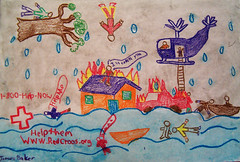
They might not repeat that lesson the same year, but the following year when they’re covering the same part of their curriculum they might just remember how that crayon and watercolor project helped reinforce their lesson on hurricanes.

It means I’ll need to plan something different each year, but that’s OK – I think it’s fun.

Send me audio! Hear yourself on my upcoming 100th podcast spectacular! Just click here and your web browser will use your computer’s microphone to send me an audio comment.

I’ll accept just about anything, including simple greetings or congratulations, shout-outs, reviews of products or services, commentary on recent events, or even plugs for other podcasts.

This is, of course, provided everything is kid-safe.

Think of it as free advertising that will reach an exclusive listener base. And yes, by “exclusive” I mean “small.”

Academic Aesthetic Podcast 89

Click to listenLately I seem to have been bitten by the DIY bug.
DIY, for the uninitiated, stands for “Do It Yourself” – mostly because DIY enthusiasts would much rather put their own embellishments on everything they touch.

And with the internet it’s easy to find plans for hundreds of DIY projects – from using a soda bottle and some kitchen supplies to make an effective mosquito trap to attaching some remote control servos and a digital camera to a kite for some sweet arial photography.

The great thing about DIY is the wide variety of projects. You can pick something to do that’s as easy or as difficult as you want, and if you’re unhappy with the plans you’re given you can always modify them to see what happens.

I’ve been making my own t-shirts and web sites for over a decade now, but recently I’ve started branching out by creating handmade business cards, and most recently a wallet out of duct tape. (My next project will be a camera bag.)

Of course the spirit of DIY can be taken to school as well. For example:

After a Language Arts project where you have the students form groups to write their own stories, you can have them type them into PowerPoint to illustrate them and even record themselves narrating the tales. Instant zero-cost publishing!

Have the students use PowerPoint or any one of a number of programs that allows for visual design, and print the finished product on a t-shirt. Admittedly there is a bit of a cost for this, but if you shop around at office supply stores you should be able to get iron-on transfers for around $1 a sheet.

How about an analog example: Want to make a quick and easy seating chart? Use a sheet of posterboard and some post-it notes. Any time you move the desks around you can just move the notes. (And if you leave these babies on your desk you won’t have to deal with substitutes saying “Well I couldn’t find your seating chart!”)

There are also a few online enterprises that are more than happy to make your DIY experience a little easier:

  • Makezine.com – more DIY ideas than you can shake a stick at.
  • Instructables.com – from the makers of Makezine.com, these are user submitted DIY tutorials.
  • Google Pages or WikiSpaces – make your own website for free.
  • Lulu.com – publish your own book, for school or yourself.
  • OriginalWorks.com – Students can have their artworks placed on a variety of products and have them made to order as a school fundraiser.

Send me a message!Hear yourself on my upcoming 100th podcast spectacular! Just click here and your web browser will use your computer’s microphone to send me an audio comment.

I’ll accept just about anything, including simple greetings or congratulations, shout-outs, reviews of products or services, commentary on recent events, or even plugs for other podcasts.

This is, of course, provided everything is kid-safe.

Think of it as free advertising that will reach an exclusive listener base. And yes, by “exclusive” I mean “small.”

Academic Aesthetic Podcast 88

Click to listenToday I’d like to talk about a little thing the art community calls “Form vs. Function,” and relate it to education in general.

An item’s function, as we all know, is what it does – what it’s purpose is. Form, on the other hand, is what it looks like. Both can be equally important, but not always.

Take the chairs in a classroom, for example. Sure, they were designed by someone, but at the end of the day their main purpose is to lift the students high enough off of the floor so they can use their desks. Their color was most likely determined by whatever was cheapest or easiest.

On the other hand, a painting puts much more weight on it’s form. In fact, it’s form is so important that looking nice is also it’s function. (This is, of course, assuming it’s not there to cover the spaghetti stain your three year old managed to put on the wall.)

Think that since you’re not an artist this doesn’t apply to you? Think again. When’s the last time you sat through a workshop filled with pertinent information, but was still so dry in it’s presentation that you remembered nothing afterwards? Or maybe the PowerPoint slides looked nice but added nothing to what the speaker was saying?

As a traveling art teacher I’ve seen a lot of classrooms, and I’ve seen far too many teachers who put the function of teaching so far ahead of the form of teaching that student retention is almost nil.

I could just tell the students what they need to know, give them a test, and move on, but how many of them would really learn?

No, like a well designed car I need to both get the students there and … well … look good doing it.

As those of you who are teachers get ready for the new school year, I want you to think about how you can balance form and function in your lessons. Will your desks be arranged in the same boring grid, or will you break it up a bit? What posters will you have on your walls? (If you don’t have enough posters, have your students make some that tie in with your curriculum.)

What will your class website look like?

And there’s more to it than just how your room appears. When you’re presenting your lesson, will you be hiding behind a podium or moving about the room as if it was your own personal stage? More activity shows you have more interest in the subject, and while that doesn’t necessarily make sure the students will learn, just try to teach them the same thing if they think that even you aren’t interested in long division.

Send me a message!In other news, I’m thinking about playing some audio clips on my 100th podcast which I should reach sometime in late August, provided I don’t get sidetracked somehow. I’ve decided to accept just about anything, including simple greetings or congratulations, shout-outs, reviews of products or services, commentary on recent events, or even plugs for other podcasts.

This is, of course, provided everything is kid-safe.

Think of it as free advertising that will reach an exclusive listener base. And yes, by “exclusive” I mean “small.”

If you want something played during my 100th podcast, record it and send it to me. I’d prefer it to be in MP3 format, but I’ll accept other file formats if they’re not too large.

DOPA Alert!

Swiped from Will Richardson, who in turn swiped it from David Warlick:


ALAWON: American Library Association Washington Office Newsline

Volume 15, Number 73

July 25, 2006

In This Issue: URGENT ACTION ALERT: Call Representatives TODAY and ask them to oppose DOPA

URGENT Action Needed:

The Washington Office has learned that the House may try to expedite
passage of H.R. 5319, the Deleting Online Predators Act (DOPA),
TOMORROW, July 26th.

PLEASE CALL YOUR REPRESENTATIVES TODAY and ask that they oppose HR 5319. Capitol Switchboard number is: 202-224-3121.

Background:

DOPA is sponsored by Rep. Fitzpatrick (R-PA) and supported by the
House Republican Suburban Caucus. It would require that, as a condition
of receiving E-Rate support, all schools and libraries block access to
social networking websites and chat rooms.

The bill raises a number of issues:

1) Local school districts and libraries should determine what
content should flow into schools and libraries. Federal mandate over
content control is very problematic.

2) Districts and libraries already have the power to block access to
social networking sites and chat rooms and a number of them have
already done so.

3) DOPA imposes yet another burden on schools and libraries
participating in the E-rate and may deter many from continuing to
participate.

4) This bill paints an unflattering and distorted view of the Internet
as a whole, serving to scare away parents, students, teachers and
librarians from making use of all its resources.

Last week, YALSA Executive Director Beth Yoke testified on DOPA
before the House Subcommittee on Telecommunications and the Internet on
DOPA. You can read her testimony here:http://www.ala.org/ala/washoff/WOissues/techinttele/DOPA_testimony.pdf.

Academic Aesthetic Podcast 84

Click to listenIn this podcast I talk about being famous for fifteen people.

In addition to silkscreened soup cans and pop culture icons, Andy Warhol gave us the quote “Everyone will be famous for fifteen minutes.”

This statement has often been rehashed as people earned their own 15 minutes of fame (American Idol rejects, anyone?), but nowadays it’s more likely that everyone will be famous for fifteen people (according to people like Steve Dembo).

Don’t believe me? Well, you’re already famous … relatively. (I’ve talked about this before, although this time I’m going in a slightly different direction.)

Look at your students. Have you ever run into them outside of school? Did the older ones call out to you, smile and wave? Did the younger ones eagerly point out to their parents that YOU were their teacher?

I thought so.

To your students you ARE famous, more so than most politicians or heads of state. Granted this can make many of us uncomfortable, but I think that’s a good thing. If we’re uncomfortable with fame, then we know our ego isn’t totally out of control.

I’ll admit I’m a bit of a ham when I get up in front of a class, but at the DEN National Leadership Conference I was still genuinely surprised every time someone said “Oh, YOU’RE the Art Guy!” I know my students think I’m famous, but I didn’t expect to be so well known by other teachers.

I wasn’t alone in that. Josh Wolff, the Discovery Educator Abroad, is a teacher from New York that had the opportunity to tour the Pacific Rim while taking photographs and creating video webisodes. He knew they were going to be used for educational purposes, but nevertheless he seemed quite shocked when I told him my Kindergarten kids loved his webisode on visiting a tropical zoo.

He was reaching a wider audience than he had expected, and seemed visibly taken aback by that.

Naturally, I then did what any self respecting educator would do at that point – I got my picture taken with Josh, so this year I could show off to my students just how famous I am.