MICCA09 Session 2 Plurk Log

theartguy MICCA Session 2: “Gaming: How do I get Started?” with Dr. BJ Gallagher

  • April 21, 2009 at 11:28 theartguy says Slight delay while scrounging for a laptop.
  • April 21, 2009 at 11:30 theartguy says Handout is a wiki: begingaming.pbwiki.com/
  • April 21, 2009 at 11:31 theartguy says Came up with using games in education while working with special needs kids.
  • April 21, 2009 at 11:33 theartguy says Most games are “Drill & Practice,” others are a little more adventurous.
  • April 21, 2009 at 11:34 theartguy says “Complex Games” are the way to go, though there is a learning curve for some.
  • April 21, 2009 at 11:36 theartguy says “If a student’s in a wheelchair, they can pick an avatar that can get up and move!”
  • April 21, 2009 at 11:37 theartguy says Mention of Runescape – she was cooking shrimp in the game and fought a troll. Heh.
  • April 21, 2009 at 11:39 theartguy “If you want to get started find yourself a middle schooler. Not a high schooler they know too much.” :D
  • April 21, 2009 at 11:41 theartguy Somewhat brief mention of MMORPGs while looking at Wikipedia article on gaming.
  • April 21, 2009 at 11:43 theartguy says I’m somewhat confused – not about the gaming, but about the presenter’s enthusiasm. She seems enthusiastic … but not.
  • April 21, 2009 at 11:44 theartguy says Universal Design for Learning, Differentiated Instruction, games can be used to support these systems.
  • April 21, 2009 at 11:48 theartguy says “How are our games perceived around the world?” A good point is made here, some of our games don’t fit well with other cultures.
  • April 21, 2009 at 11:49 theartguy says World of Warcraft removed a character based on a panda because China didn’t think it was a positive image.
  • April 21, 2009 at 11:52 theartguy says I see how gaming can be used to assist education, but she could be making the connections better than “Here’s some links on some sites.”
  • April 21, 2009 at 12:31 Tim Holt says keep these updates coming!
  • April 21, 2009 at 12:38 theartguy says Next two sessions are mine – think my audience will mind if I stop to Plurk? ;)

MICCA09 Session 1 Plurk Log

theartguy Session 1 is What Google Can Do For You by thetechtiger! Woot!

  • April 21, 2009 at 10:11 theartguy says im.textthemob.com/id751
  • April 21, 2009 at 10:32 miz mercer Back to being artguy I see
  • April 21, 2009 at 10:38 theartguy says For now at least – don’t want to confuse the people I introduce to PLNs today.
  • April 21, 2009 at 10:39 theartguy says Currently explaining Gmail & Gchat
  • April 21, 2009 at 10:43 theartguy says It’s all a quick overview of everything right now. Cal, Docs, Maps, Earth
  • April 21, 2009 at 10:44 bethmharvey says I love the site “text the mob” I have never seen that. Good luck on your presentation. Our teachers are most interested in Google Docs
  • April 21, 2009 at 10:45 theartguy says “If you can use Office, you can use Google to make web pages.” So true :)
  • April 21, 2009 at 10:47 theartguy says Best part about Google Docs is no more thumb drives to transfer documents. IMHO
  • April 21, 2009 at 10:47 theartguy says Side note – this isn’t a PowerPoint. WHole thing is in prezi.com/
  • April 21, 2009 at 10:49 theartguy says Google Groups – discussion boards. Can be public or private. Lots of good ones already exist.
  • April 21, 2009 at 10:52 theartguy says iGoogle
  • April 21, 2009 at 10:56 theartguy says Overview done, now for the nitty gritty!
  • April 21, 2009 at 11:02 theartguy says Form – create a web based survey (or quiz or test!) and all answers are placed in a spreadsheet! I use this all the time and it’s awesome.

MICCA 09 Keynote Plurk Log

theartguy Keynote for Day 1 is Karen Cator from Apple. Lots of good ideas, though many are common amongst keynoters.

  • theartguy says Web 1.0: Watch Tv and try to understand commercials.
  • April 21, 2009 at 09:15 theartguy says Web 2.0: Produce media
  • April 21, 2009 at 09:17 theartguy says “Get out of the notion of giving kids something to do every 20 minutes.” They need to manage their own time.
  • April 21, 2009 at 09:18 theartguy says “When you want to learn something new, what do you do?”
  • April 21, 2009 at 09:22 theartguy says Showed a video of a 10 yr old video blogger. Kid mentioned a JoCo song. Nice :)
  • April 21, 2009 at 09:22 techtiger I really liked that kids are the CEO of their own brand
  • April 21, 2009 at 09:24 theartguy says Enabling trends: Mobility – 24/7 access & user created content.
  • April 21, 2009 at 09:26 theartguy says Indeed, thetechtiger – It was rather “permanent record”-ish, but in a good way.
  • April 21, 2009 at 09:27 theartguy says Also enabling: Social Interactions for Learning. Social interactions are PROMOTING learning.
  • April 21, 2009 at 09:34 theartguy says And just got a link from timholt about being a Keynote speaker.

Help me at MICCA!

09confwebbanner2

For the 4th year in a row, I will be presenting at MICCA.

For the 1st time (for this conference, at least…), I will be presenting twice.

And as usual, I’m opening my handouts up to everyone who wants to add in their two cents.  I feel they’re ready to go as-is, but that doesn’t mean I’m the only person who knows what he’s talking about!  (I’m hoping for supplementary information, not for someone to do the work for me.)

My presentations are as follows.  Click the links to see, edit, and/or add to my wikis:

Art 2.0

…how art lessons in the computer lab can reinforce other subjects.

Paper, pencils, and paints are good, but there are also plenty of free art projects that reinforce other subjects and can be taught using just computers. This session will showcase some tools, tips, and tricks that any teacher can use.

Personal Learning Networks

…how microblogs and more can make you a better teacher.

Personal learning networks (also called professional learning networks) are a quick, easy, and free way to continue your professional growth as an educator using web 2.0. This session will explain PLNs in more detail and show a variety of free sites that can be used to build your own.

Don’t mind the shavings.

Garbage never looked so good.

I handed colored pencils to my 1st graders today.

This was not too surprizing, as I did the same thing last week.  What I have noticed, however, is that most of my teachers with younger students don’t let them sharpen their own pencils whenever they need to.

I, however, do.  I would much rather see a student raise their hand because they’re having difficulty with a portion of their composition  than because their colored stick isn’t pointy enough.  As a result I usually announce in the beginning of the lesson that if the pencil needs sharpening, they can just get up and sharpen it.  I even go so far as to explain when a pencil needs sharpening and how to sharpen it so that it doesn’t disappear forever in a pile of shavings.  (Colored pencils are much softer than the 2B kind.)

You know what happens next…

Stampeeeeeede!
Stampeeeeeede!

That’s right, any student who found a colored pencil that was not ready to vanquish a vampire was at the sharpener ready to go! This included those who had white colored pencils.  Did I mention this was a lesson where they used white paper?  Well it was.

This is the point when the classroom teacher looks at me with a patronizing expression that says “That’s why I don’t let them do that.”

And I look at them with a nervous smile that says “Eheheheh … I’ll be right back.”

The next minute or so is spent turning kinds away that don’t really need to sharpen pencils, as well as enforcing the “Turn it 3 times then check” rule of sharpening.

And you know what?  That’s it.

Occasionally a student will have a relapse, but for the most part they know my rules and what’s expected of them.  They’re fine with that because they’re getting a cool reward in the process – an awesome art project.

In fact, I wouldn’t be surprised if the initial stampede was in fact because they wanted to revel in the idea that they could go and sharpen any pencil that needed it.

So how does this relate to technology integration?

You have to ask?

A new tool is a new tool, and new freedoms are promptly exercised.  There will be chaos, but if you stay alert it will at least be organized chaos and learning will still be accomplished.  Eventually, the chaos will be replaced with something better – a class full of students who are able to learn without raising their hands to ask permission for each step.

I’m not sayin’.

I dont know the answer either, kids!Dan Meyer seems to have come across a recent theme in his lessons: he’s not giving them the answers. I think that’s awesome.

This is something you could very well expect to see in any art class that has a good teacher, since in art you will often find three or four (or more) opinions about composition, color choices, techniques, or even the definition of “art” itself.  We can’t give a single answer because there isn’t one.  We’re kind of forced into the scenario of not giving an answer at the end of the lesson that students can expect to see on the final.

Mr. Meyer, however, is a math teacher.  There are very concrete answers that can be figured out when encountering math problems.  Two plus two has an answer.  If solving for X yields more than one possibility, you can graph them to show the whole range.

Sometimes the conversation, the act of sorting things out with your peers and learning for yourselves what the right questions are is more important than coming to a specific teacher-sanctioned conclusion.

Giving an answer at the end can disguise that simple fact.  I’m glad he’s realized this so early – I know more than one teacher twice his age who’s yet to have that sink in.

What’s in a name?

I have over 2,000 students (not including teachers who are also, technically, my students) spread out over three schools.  This is a daunting task for many reasons, but only one of them irks be to the point that I’ll mention it at the start of this blog post:

I can’t remember that many names.

Oh, I’ll make valiant attempt.  There’s a handful of students whom I do know by name, but there’s just no way I can learn who everyone is when I see them so rarely.

They do know mine though … well, most of them.  To some of my students I’m “Mr. Smith.”  To others, I’m “The Art Guy.”  At the insistence of some teachers in one of my buildings some call me “Mr. Aaron,” though I’m not too keen on that.

artguy128In any case, I’ve been thinking a lot lately about my “Art Guy” moniker.  Originally it was a name given to me by a student, and it sort of stuck.  It smacks of just enough irreverence to make it amusing to me even though some classroom teachers who don’t know me try to correct their students when they hear it.

It’s a great nickname to have when you’re the only art teacher around, or failing that the only one that’s a guy.  For that very reason when I started my first forays into edublogging and podcasting to find there were no other art teachers playing with the same technology that entertained me so much (at least none that I saw…), “theartguy” seemed like a perfect screen name for me.

Art_Guy_Shirt.jpgAnd it has been.  I have found countless friends and joined more Web 2.0 sites than I can remember using that screen name.  It’s how I’m identified by pretty much anyone on the internet who knows me.  My target audience has never been limited to just other art teachers – far from it in fact, because in the beginning it was such a rare occurrence to find one of us blogging.

But times change.  These days I’m far from being the only artsy person out there with a blog/podcast/vidcast/and so on., and I think that’s totally awesome.  When I got started I brought an art teacher’s perspective to these new technologies with which we were playing, because in some cases it was quite different from a [insert any other content area here] teacher’s perspective.

Now, the art teachers that are blogging have their own little corner of the internet to form their Personal Learning Networks.  Networks where they don’t have to start off by saying “As an art teacher…,” because their target audience is other art teachers.  Again, this is awesome.

But it also means I’m not the only “art guy” out there.

If I walk into a room full of 30 students ready for an awesome painting lesson, I have no problem calling myself the Art Guy.  If I walk into a room with a decent percentage of other art teachers … I hesitate.

There is more I want to say, but this post is long enough for now.  Expect another installment later.

Prove Me Wrong

WARNING:  I’m either on a high horse or a soapbox grandstanding with an overinflated ego right now.  I’m not always this smug or confrontational (I hope…), but some recent events have led up to this post.  Read at your own risk.

HPIM5128.JPGI do the impossible. Daily.

“He won’t do any work. Just let him sit there.”

“This class will never be controllable when it’s snowing outside.”

“These special ed. students don’t have the hand-eye communication to use scissors.”

Each of these statements is something I’ve been told by a classroom teacher. Each of these statements have been proven wrong.  See that photo?  It was taken by a 2nd grader, then submitted to a juried art show.  It got in.  Don’t tell me photography can’t be taught to 2nd graders.  I could add more examples, but do I need to?

It is a personality flaw quirk of mine to, when I hear something cannot be done in the classroom, see that as a challenge.  Sometimes it turns out the chalenge issuer was right, but more often than not I get to show them what a little effort and guidance can accomplish.  They had given up on those students because they did not think they had the time and/or the energy to accomplish the aforementioned tasks and teach the prescribed curriculum.  Understandable how they got to that point – I’d be there too if I was in their position – but that doesn’t mean I’ll let it stay that way.

So…

When a classroom teacher tells me they’d love to include more art in their lessons, but they just don’t have the time / energy / creativity / inspiration to do that and cover the mandated curriculum….

Challenge issued.

Challenge accepted.

Just don’t keep saying it can’t be done after I prove you wrong.

What have we learned?

Its a winner!

I’m spending most of this week organizing, labeling, and hanging pieces for the Youth Art Month Expo’s juried art show.  It’s a lot of work, a lot of fun, and I get to be in the same room as other art teachers.  Beware!

While sorting the untold piles of art I couldn’t help but think of my own art classes.  Not the ones I teach, mind you – I’m talking about back when I was in high school.  Back then I was a bit of a geek.

Um, OK, so I still am.

But while now I’m an outgoing extrovert of a geek with an ego larger than the Hindenburg, back then I was an introvert with very little self confidence.  The only class where I felt I could really speak my mind was art, and that was because Mr. Lichner promoted the kind of environment where good ideas were rewarded and negative criticism had no place.  When one of us came up with an art project that had nothing to do with his idea for what projects he wanted us to do, he still encouraged us to explore the possibilities allowed to us by the media to which we had access.

If all of my classes had been like my art classes, I can assure you my parents would have been much happier with my report cards.

And so, since I was thinking about this, I posed a question to Plurk, Twitter, and a few other outlets.

What’s something you’ve learned from an art teacher?

The results were rather interesting, I thought.

There is no such thing as a mistake, only opportunities to create more. - Laurie Korte

Do the opposite of what you normally do. Completely ended up changing my style and medium. – Judy Shintani

It’s all in the details, take a second look, never be afraid of color. – Selena Ward

“There are no mistakes. Only happy accidents.” Kindergarten art teacher. She was right. Mostly. – Bud Hunt

You can always throw it out and start over :-D – Jacqui Derby, Ph.D.

To properly observe something, sometimes you need to look closer. – Beka Smith

There is no such thing as staying in the lines.. Patti Duncan

[The] law of perspective. Patti Duncan

Part of me feels the need to comment on each of these individually, but I think it’s better to let them stay as-is.  What I will say is that each person who responded took something useful and meaningful back with them when they left their art classes.

As the powers that be wring their hands and look at budgets that are stretched too thin to fit everything, it is my hope that they too will remember what they learned in their own art classes.

So what have you learned?

I know too much.

I spent the first half of this school year taking a graduate class that was required for me to renew my certification.  It was a good class, and I learned a lot, but it did take a decent amount of time each week for me to complete the assignments.  (Had it not done so it possibly wouldn’t have been a good class, but that’s an assertion for another day.)
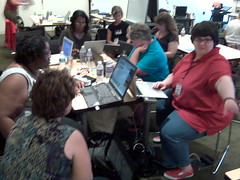
I miss these people.

The class ended in December, and I began looking forward to all the “free time” I would have.  “Free time” is in quotes, of course, because my time was not actually free before I enrolled in that course.  I simply put off some responsibilities for others.  You may have noticed I’m blogging a little more now – that’s one thing I’d been neglecting, and I apologize for that.

Unless you liked the fact I was blogging less, and in that case I’d apologize for my return to the blogosphere if I wasn’t wondering why you’re reading this in the first place.

*Ahem.* Let’s move on.

As I’m getting back into the swing of things I’m noticing that conference season is in full swing.  MICCA‘s deadline to submit presentation proposals is almost here, NECC is local-ish this year, and PETE&C is just around the corner.

Discovery rocks!

That brings my rambling to a topic worth discussing.  Every year the Discovery Education Network runs a day long pre-conference for PETE&C.  I’ve attended more than once, and every time I felt it was worth it.  Forget the fact that it’s held in Hershey, PA, a town that smells like chocolate for very obvious reasons, it’s also free for DEN Star members.  I’ve held that status for a while now, as do many of my friends who I will only get to see in person at events like this.

And I’m thinking of not going.

It’s not because of my wife’s health.  Though she’s not at her best right now, I honestly think she’d enjoy and benefit from a weekend out of the house.  (Though I shudder to think how much money she’d spend in Hershey, that’s only me fulfilling my stereotypical duty as a husband.)

It’s not because of the cost.  Gas prices are relatively down, and I have family that’s somewhat close to Hershey where we could spend a night or two if needed.  I’m not attending the full PETE&C conference anyway, so that price isn’t even a factor.

It’s because I’m not sure how much I’d learn.

OK, that sounded like a jab against the DEN, so let’ take a moment to explain it a little better.

These people rock!

On the grand scale of technological geekery (yes, I made that word up), where a 1 means I have trouble checking my email and a 10 means I can whistle into a phone line and get a 56k connection, I’m about a 4.  To people who rank 1 or 2 I appear to be a 10, but I know better.  Right now I’m at the stage where the more I learn, the more I find out how much I don’t know.  It’s exciting and depressing at the same time, because I really would like to know everything.

… but maybe not reach 10 on that scale – I can’t whistle very well.

Back on topic.  The DEN is awesome because they take teachers, many of which are 1 and 2 on the aforementioned scale, and turn them into 3s and 4s.

But I’m already a 4, which means I’m not learning as much.  Google Earth is great, but I don’t need to see another workshop that explains why it’s great.

The DEN blogs?  An awesome, free service that’s worth checking out.  When new features are added I like to know about them, but that’s because I want to know if I should install them on my own blog.

Discovery Education Streaming?  The Builders?  Microblogging?  Digital storytelling?  I could go on, but I don’t need to.  There’s more I could learn on each of these topics, but I strongly doubt I would learn much because I’m not the DEN’s target audience at this pre-conference.

If I did go, it would be to socialize.  To see people face to face that I haven’t seen in months if not longer (and in some cases never, much to my regret…), and to share with each other what we’ve learned and experienced over that time.  I’d like to do that.  To me it’s one of the most enjoyable parts of a conference – any conference.

But if I do that, I’ll probably be filling up a spot that some one else could have used.  Someone who may very well need the DEN to teach them the things that I already know enough about to run my own workshops.

I don’t think that would be fair to them.

So I really hope those of you that will be at PETE&C this year will be liveblogging it, if for no other reason than to let me live vicariously through your posts.  You don’t have any excuse not to, since you already have a blog provided to you by the DEN.

I’ll be watching.